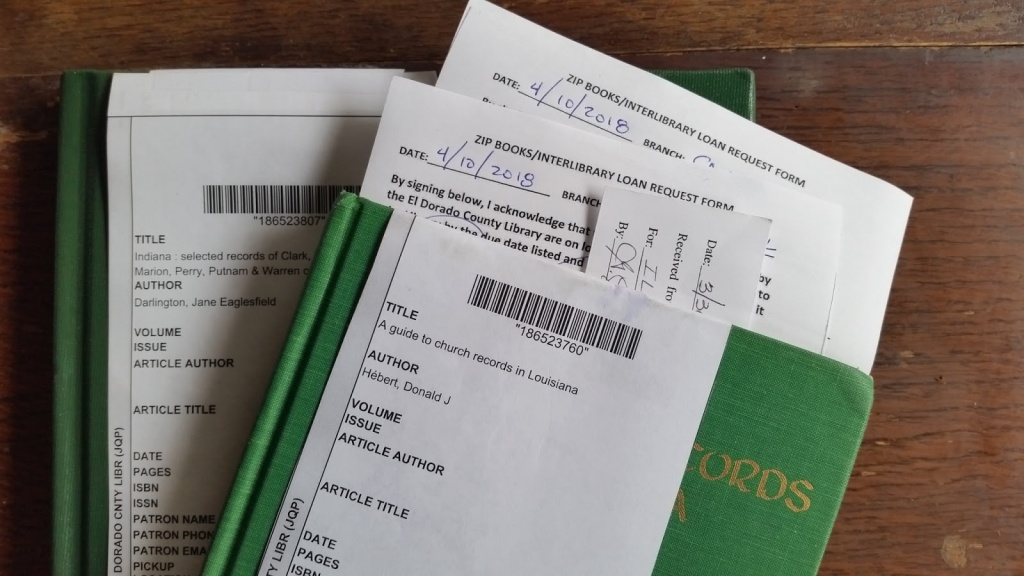
I’ve posted my approach to visiting a research library elsewhere on this blog. It’s all about books and other written materials. I can get anything on the computers at home, and nowadays, even information found on films (microfilm and microfiche) can typically be found online or at the local Family History Center. So, when I’m in the library, every second is devoted to the stacks.
But, what about all the time when I’m not in the library? Well, I’m listing what I want to see when I return. Generally, I’m preparing to visit the Family History Library (FHL) in Salt Lake City. Still, I use other libraries, such as the Sutro in San Francisco and university libraries.
The time between library visits is when you will find me using my Secret Weapon – but it is not a secret. Underused, perhaps altogether forgotten, but not secret. I’m talking about the Inter-Library Loan, or ILL for short. I use the heck out of this – two books at a time!
Most of the books we encounter in mainstream genealogy can be found at the FHL. Some are digital, but most are not now; others will not be digital because of permissions and copyright. Still, others can’t be had at the FHL for some reason. So, for those hard-to-find books, I will make an ILL request. Likewise, books out of the mainstream of what we think of as genealogy books may not be found at the FHL. History books, for instance. You will need the ILL if you’re not taking a road trip.
In a recent example, the FHL didn’t have the book. The closest copy to me was in Fresno (four hours away by car), and it was in-library use only. ILL to the rescue! I think the copy I ended up getting was from St. Louis.
Even if I can see a given text at the FHL, my time there is limited. There isn’t time to sit down and read at the FHL. Typically, I’m taking scans of what I need from the book and moving quickly to the next. Not so when I have a book on ILL. In every case, I’ve been able to read – really read – and this always yields data I didn’t even know I wanted. In the research process, one item should move you forward to one or more other items.
So, my process goes like this:
1) Research identifies a bound volume that may be useful or interesting.
2) Create a Task List assignment to view the item tagged to a person or family in most cases.
3) Check WorldCat for the book’s availability.
4) Check on Amazon or eBay. If the book is something I’d like to own, I will buy it.
After these steps, I will eventually see each book on my list. The ILL or short trips to local repositories could do all the work given enough time. My visits to the FHL puts everything into fast forward.
Here are a few tips about ILL:
1) Turnaround time will be less for books you get from ILL. Your local library needs to have the book returned to the lending library by a specific date, so your time will be shortened. For this reason, pick up the books as soon as they become available.
2) Drop any other research you are doing and focus on getting as much out of your time with the ILL book.
3) Return the ILL book as early as you can. This shows the librarians you are responsible. They will get to know you.
4) Have a new ILL request in hand when you make a return. Keep the cycle going.
5) Keep track of the requests you’ve made. I track them on my Task List. Here is where I record the date I made the ILL request, when I got the book, and when I returned it.
6) If you must pay a fee (my library gets $3 a book), get a receipt. At least in the case of my little local library, ILLs are not routine. There seems to be some confusion about when a patron pays for the book. If I keep my receipt, I can avoid the confusion.
7) Try to get a receipt for the return of the ILL book. My library refuses to do this for me – though I always ask. Things get lost, and several hands are in the mix in an ILL transaction. I always note on my Task List the date I returned a book.
So that is my Secret Weapon. I’ve been working with this system for about two years; only once was a book unavailable.


 Aaron Tassin, MLIS