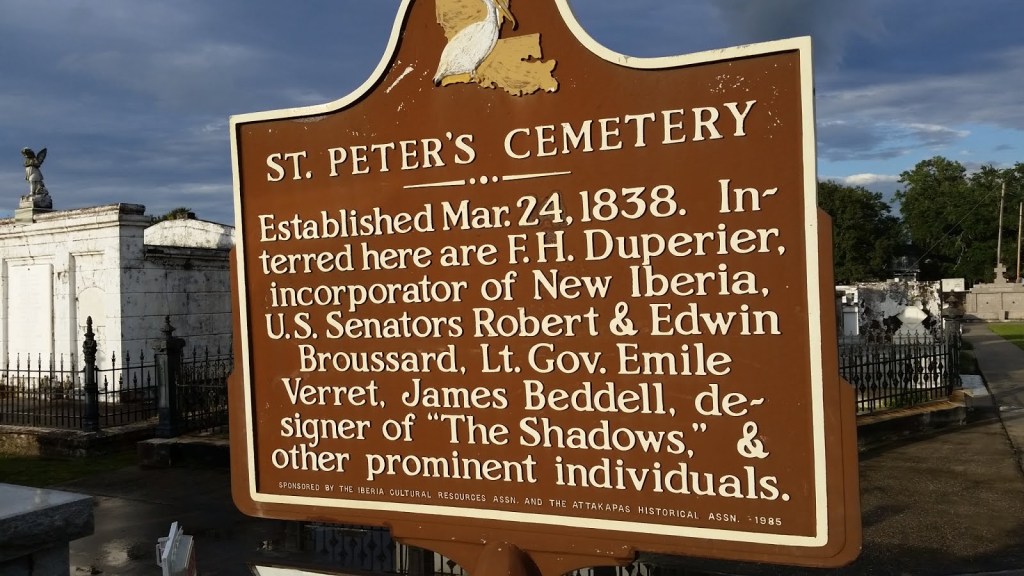
I’d been to several places on the day of my first visit to the historical cemetery, St. Peter’s Catholic Cemetery in New Iberia, Louisiana. Without a doubt, this stop would be the most exciting.
St. Peter’s is a quintessential Louisiana cemetery. It is absolutely fascinating, and I would argue it is beautiful in its own way. I was here with a mission in mind…find my missing second-great-grandfather, Hildebert Theriot, and, if possible, his wife, Louise Elmina Delahoussaye. I’d already done as much as possible from California, including speaking a few times over the phone with the cemetery’s pro bono manager. Everything I had up to this time pointed to Hildebert and Louise at rest here. If I couldn’t find them, I’d have an explanation for why.
The cemetery is located at French and Pershing Streets in New Iberia, about one block north of the courthouse. The cemetery manager and maintenance supervisor knew I’d be in town and kindly met me near the main entrance. Both men have devoted much of their free time to caring for this historical treasure. The maintenance lead has generations of his own family at rest here, and his family is mine! Yes, he and I are third cousins on my Theriot line. His second-great-grandfather and my second-great-grandfather were brothers.
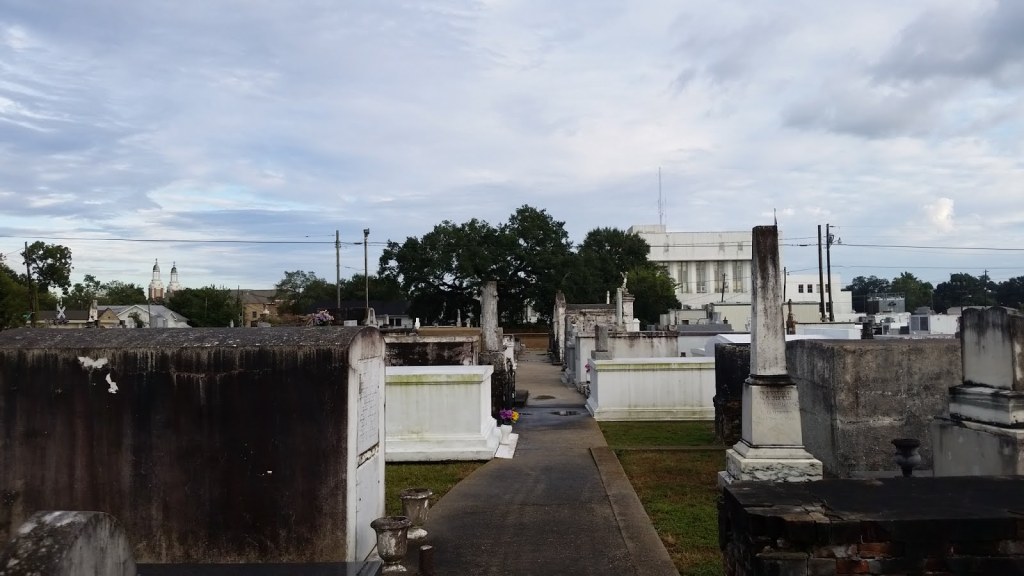
October afternoons in Southern Louisiana are predictably rainy. The three of us sat in the cemetery manager’s truck as both men explained the history of St. Peter’s Cemetery, records that survived and did not, yellow fever, unreported burials and removals, unreadable and unidentified grave markers, and the like. Theirs is a story of doing their best with the information available. Taking notes and fearing I’d not find Hildebert and Louise on this trip, I took it all in. Everything pointed to St. Peter’s – most significantly records from the catholic dioceses.
St. Peter’s Cemetery is about 200 years old. Available records establish 11,000 names of persons interned, yet of this number, about 6,000 cannot be placed at a known grave site. Conversely, there are about 300 unmarked grave sites.
The cemetery is generally laid out in a grid with significant walkways crossing from top to bottom and left to right. But be careful; some of the pathways of the major walks don’t always line up. Today, all the graves identified are in a database. Many are already on Find-A-Grave. More grave sites are identified from time to time because of proactive outreach.
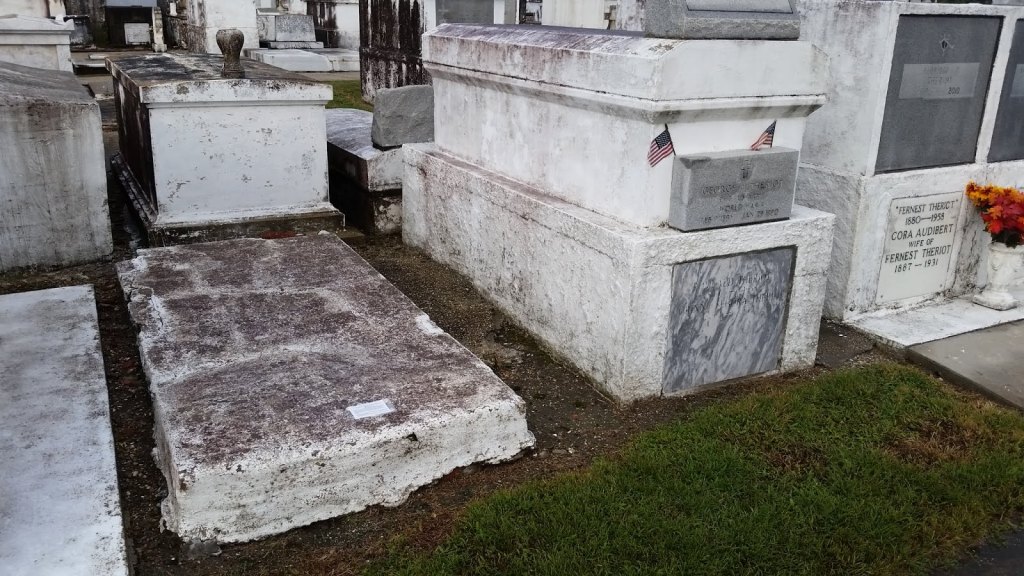
After the rain stopped, I found some Theriots but not Hildebert and Louise. There is a grouping of Theriots, among them a few unidentified grave sites. My suspicion is they are here. Concrete interments give away the age of a grave site.
While more research is needed, a detailed report documented my “reasonably exhaustive research” to date. In such situations, a genealogist can only keep pushing, re-evaluating, and continually searching.





 Aaron Tassin, MLIS